
I wrote this play, in the vernacular of the Nottingham accent, about the fate of British Soldiers from Nottingham and Newark and Derbyshire, who were sent to Ireland in 1916 to crush the Easter Rising. Yet to be performed, so if you know any theatre groups in the East Midlands – drop me a line!
Dublin days
The Sherwood Foresters and the Dublin Rising
Private Arthur Winfield’s memoir of the fighting in Dublin 1916
Do yer see this ‘ere badge. Sherwood Foresters regiment, yer, that’s right, the Robin Hoods, that’s who we wer, an’ I’am goin ter tell yer what happened us in Ireland wen we was sent ter crush theer rebellion.
We sailed out of Liverpool, 2 Battalions o’ us, bound fer Dublin. Never bin on a ship, moste of us. Moste of us ‘ad never been out o’ Nottingham ter be ‘onest, ‘cept fer odd day trip ter Skeggy, but we wer Robin Hoods now, soldiers. An yer go wer yer toad when yer a soldier.
Me mait Baz, he wer me neigbour an’ we’d worked tigether at the Ralleh, he’d bin ter Ireland before. He wer a bit oader than moste of us an’ he’d worked on’t ferries fer a bi when he wer a youth, but none o rest us knew owt about ther place. Adjutant, he’d bin theer. He wer married ter a lass from’t Dublin, so he knows the place a bit, he gis us a lecture abaht it on’t way over. Toad us Dublin were about same size as Nottingham, ‘ad a castle like we did, but ther wernt t so many factories as we ‘ad, and ther wer a lot more children on’t streets. He said ther were a lot of poor folk there, lot o slum ‘ouses.. Someone asked if wer as bad as the Narrow marsh He thought a bit then he sezs “No” in his posh public school accent “No, its not that bad”
Toad us Nottingham ‘ad bin sending sojers to Ireland fer hundreds o years. Sherriff ‘o Nottingham, he said, we all know Sherriff, well back in twelve hundred and someat, King Edward ordered Sherriff ter send his best archers ter Ireland wi’ theer bows an’ arrows ter fight fer the King an’ put downe rebellion. And now, he ses, It wer our turn. He sezs Nottingham sojers ‘ad fought in Ireland wi wi bows and arrows, swords an pikes, muskets an cannons and now you lot, Robin Hoods, he sez, goin theer armed ter teeth wi modern rifles.
Baz said it wer arwrigt fer him ter say that, but half of us ‘didn’t know how to fire us bloody modern rifles,
“we weren’t ready fer fightin” , he sezs, “ ‘addent finished us training yet, we weren’t proper soldiers”
Adjutant toad us we’d likely be welcomed by most o’ the Irish. 100,000 of ‘em, were in’t Irish regiments, already fignting in France he sez. They wer not all rebels he said. We was to be courteous ter ‘em if we could. “ They don’t all ‘ate us” he said, “some o’ them quite likes us. I;m married one o’ them!” he sezs
Giv us a bit ter think abhat that did, as we sailed across ter Dublin.
He wer right abhat us bin made welcome. At docks in Kingstown there wer hundreds of ‘em, clapping and cheering, whooping an’ hollering, there wer cups of tea, sandwiches, they med a right fuss. Someone even giv me a banana as I walked down gangplank.
An’ there wer hundreds of us gerring off boat, other regiments, lads from Lincolnshire’s, an Staffordshire’s, an all kinds of units, medics, cooks, all ther kit, waggons, ’horses and what have yer.
Officers had theer breakfast in a right posh yacht club, “full Irish” said Baz. Yer could smell bacon drifting across ‘arbour, all we had wer bully beef, wi sandwiches that we got from local folk, wi’ lots o’ tea. ‘An me banana.
We sets off fer to march in’t ter City, Sherwood Foresters in’t lead. We wer ter march, our column anyway, straight inter center o’ the city, ter a college, Trinity it wer called. T’other column goes off ter somewhere else.
We wer marching up the coast road in’t Easter sunshine. It wer a hot day an’ we wer marching fast, us rifles over us shoulders on’t slings. Loads of locals lining streets, they wer glad ter see us, clapping an’ cheering us on they wer. We’d not bin marching ten minutes when Adjutant, ‘e couldn’t believe it at ferst, he sees his missis an’ kids on’t side o’ road, waving and calling out ter him. He wer gobsmaked! He’d toad us on boat thet we all should think of us families back in City and he obviously meant, I reckons, we all reckoned, that his own family wer still there, at ‘ome in Nottingham. But they weren’t, they was ‘ere. She’d come ‘ome, wit kids, fer Easter ‘olidays.
An ‘is missus looked bowled over an all, she ‘addent expected ter see her oad man, marching wi his soldiers int’ ter Dublin while she wer there on holiday. The little ‘uns, they looked like twins they did, they wer right excited, jumping up and down, waving at ther daddy.
Adjutant he fell out o’ column and ran over ter them, hugged and kissed his missus and ‘is kids. She wer a good looking lass too, tall and ‘andsome she wer, Big cheer went up from ranks “Giv her one fer regiment sir” someone shouts, ‘an we all ‘ad a laugh.
Sgt Major put us right,
“Aw right lads,” he sezs, softly like, “tek it easy, quieten down now, tek it steady,”
We wer getting worried abhat ‘im. The Sgt Major. He’d spent all o’ last few weeks, at Depot, shouting ‘is ‘ed off at us. All the time, shouting an’ meking us double march, here, ‘an there, ‘an everywhere, yer couldn’t do ouwt right wi him without ‘im shouting in yer face. Now, in’t Dublin, he’d gone all quiet, he’d stopped all ‘is shouting, he even spoke to us now, proper like.
“ He’s worried abhat us” said Baz, “cause he knows we arnt ready yet fer fightin, we shouldn’t be ‘ere”
He wer treating us now, Sgt Major, like we wer his family or someat. All ‘is anger ‘an shouting from’t depot, it wer all gone.
Still, when adjutant comes running back ter column, getting himsen in’ter step, we’all givs him a big cheer, even Sgt Major wer smiling a bit.
It wer abhat an hour later, we wer much closer ter city, wen some buggers fired shots at us. We wer just standing around, near some display grounds, teking a bit of a rest ‘an ‘aving a fag. Well buggers missed, missed us all, hundreds of us, standing about, shots went zipping through trees, but we all gets down behind cover as best we could. We is toad to fire on a ‘ouse about 300 yds up, where road split in’t ter two. An by heck we did. We opened fired on it fer abhat 10 minutes, mebe more. I gorroff three shots missen, but no one wer firing back. I reckon Sgt Major just wanted to giv some o’ us chance to ;use us weapons, get used to ‘em a bit, half o’ us, including missen, ‘addent fired them at all yet, not even on’t range.
We sets off agin, only this time we wus marching in a sort of a box: men on’t either side o’ road wi officers across the road up front o’ box and more at back o’ box. We wer carrying us rifles at the ready now an’ matching a bit more slowly. We ‘ad to pass ‘ouse we’d bin shooting at. It wer a right mess, peppered wi bullet ‘oles, no winders left, an’ door shattered ter splinters. We wer a bit chuffed abhat that. No one had fired back at us an’ all the rebels had run off. It wernt gonna be that bad, we thought.
It wer a lovely area, big grand ‘ouses, obviously fer well ter do, yer’d need a bob or two ter live round ther. Ther wer servant girls at the gates of some o’ the ‘ouses, wi glasses of water or lemonade and cobs an’ that, but we’d bin toad not ter take anything off ‘em anymore. Street wer lined wi’ trees, just cumin int’ ter leaf. It wer a bit like them posh ‘roads behind castle in Nottingham.
We was coming up ter this crossroad, Adjutant wer up front o’ box an I wer abaht six or seven men behind him, on left hand side o’ street. I sees this ‘ouse on’t corner, on t’other side ‘o crossroads, fine looking ‘ouse it wer, thought it probably belonged ter a judge or someat, yer know, someone important what goes ter church, ‘ad books in it I should think, an mebe a piania. Ah didn’t know then, none ‘o us did, that it wer one o’ the deadliest ‘ouses in whole o’ Ireland.
It wer quiet, peaceful quiet, ther wer a church bell ringing in distance an’ yer could hear birds singing ‘int trees. And there wer the steady crunch ’o men’s boots as we marched up the leafy avenue. Sunday kind ‘er sounds
And right sudden, wi’out any warning, ther wer this great volley of shots.
Everyone at front ‘o box seemed to fall in street. We kinda froze a bit, we ‘ad no idea wer shots ‘ad came from, but ther wer bodies now, all across street, adjutant ‘an them as wer at front o’ box. There wer bit of panic, we ran fer cover, still not knowing wer shots ‘ad come from. Sgt Major took over, he wer running abhat, steady as yer like, “It’s that ‘ouse over there” he shouts, “fire ‘on it, fire ‘on it.” I wer crouching behind a lamp post ‘an we opened up on the ‘ouse. Sgt Major grabs me by me webbing, ses, “come wi me” an we runs over to bodies lying in the road near ter a bench just outside the ‘ouse. We grabs ‘oad of adjutant, he wer wounded but still alive, an we pulls him across road int’ ter a garden. We runs out agin and pulls in another man, it wer Baz, he wer still alive as well, but bleeding a lot. Out we goes out agin, but firing wer too heavy an’ we ‘ad ter tek cover. Whole road wer wet now, wet wi’ the English blood o’ the Robin Hoods.
Sgt Major ses, “follow me” an we runs back down road wer we’d come from. He gets ten of us wi a corporal, an he ses “ Get down ter that there barracks, Beggers barracks, get down ther ‘an stop any ‘o sods comin up from that way, ‘an if they ‘ave any Lewis guns in there corporal, send me a runner” an he runs off to sort out things.
There wer nine ‘o us ‘an a corporal, we runs ter barracks but couldn’t open gate ‘an had to climb in over walls. Ther wer ‘ardly anyone in barracks, a fire picket wi’out any guns, some cooks ‘an some ‘oad fellas, reservists, they ‘ad guns but no ammunition so we give ‘em sum o’ ours., ‘An’ ther wer a major from’t artillery, he’d come in’t ter barracks same way as us, over wall. He wer local ‘an knew area ‘an what ter do. He wanted keys to armoury, but fire picket corporal said duty officer ‘ad ‘em and he’d gone ter Leopardstown, ter races. He set us up ter fire on a railway embankment, toad us that’s wer they’d come from if they wus gonna come at all.
Just as ‘e spoke, rebels start shooting at us from’t embankment.
“Gerrdown Sir, corporal shouts, but he just stood there “Return fire” he ses, calm as yer like. W’ed just fixed us bayonets and we starts to fire back, but, first shot ‘an me bayonet falls off rifle, then it jams. I wer werking bolt, in a bit o’ panic, trying to get it ter shoot.
Major he goes daft. Grabs me rifle, clears the jam, an’ raises rifle ter ‘is shoulder an’ fires two shots at embankment. He ’ throws weapon back at me. “How long you been a soldier?” he shouts.
Well I didn’t tell ‘im, but it wer only a few weeks.
“Your just recruits, bloody recruits, he shouts, “Factory scum” he ses, “ I thought you were bloody soldiers!” He were raging angry.
Firing at us from embankment stopped after a bit. But we could hear constant shooting from’t main road, real heavy stuff, non stop.
Major sent two ‘’o us out of the barracks ter the other side o’ road, “to provide cross fire”, he said. We could see an hear men running abhat behind us at crossroads, dashing down the other side towards a church, Orders being shouted, constant gunfire, not just from ‘ouse on’t corner but from somewhere further up road as well, from’t canal area.
Ther wer nowt ‘appening from embankment ‘an we didn’t ‘ave that much to do. Sgt Major came by ter see us, asked who toad us to come owt o’ barracks. Ther wer two bodies ‘int road down from’t barracks, civilians, couple of young grils. He asked who’d shot them ‘an we toad ‘im it wer lads in barracks ‘an that ther wer this Major ther who wer raging at it.
“I’m not surprised” he sezs “its not very courteous ter be shooting civis is it? “ , The Major comes running across from’t barracks, “Sgt Major” he shouts, “Have you any Lewis guns, any mortars, whose in command here”
Sgt. Major, he stands up an’ salutes him. “We’ve not got any Lewis Guns ourselves Sir, wer trying ter get some from’t Dublin units ”, he ses, “we’ve set up a headquarters back down there a bit, at a town hall” he ses, “Brigadier Maconchy ‘es ther Sir, an’ Colonel Fane, if yer local sir, an know these streets, I reckons they could use a bit o’ help.? “
“Haddington Road, Sgt Major, I live on Haddington, down there,” he pointed, “ right next to the church, of course I can help…”
“Come on sir,” an’ Sgt Major teks him off at a run, down road ter battalion headquarters .
Well, we all bloody knew that we didn’t ‘ave any Lewis guns, they’d all bin left on’t dockside at Liverpool. An’ even if we ‘ad ‘em, ‘ardly any of us knew ‘ow to use ‘em. But we was glad ter see back ‘o that major, he wer in grave danger of getting himsen shot. ‘An not necessarily by the Irish either.
They found some Lewis guns ‘cause we saw a team o ‘em come up. They weren’t Foresters though, Staffordshire’s I think. They wer wi’ the Major an’ they goes running off towards his church an’ starts shooting from’t tower
It got real heavy, the shooting. we saw abaht six men, all foresters come up road wi ‘an officer from’t Royal Engineers, Sgt Major wer wi ‘em, they wer carrying buckets full o’ hand bombs. We heard them going off after a bit, first one, then a whole bunch o’ them. Ther was cheering but shooting kept on, crack of our Lee Enfield’s, short bursts of machine gun fire from’t Lewis guns in’t tower, loud booms of some ‘o rebel guns, mostly now coming from up near the canal, bombs going off.
A Corporal came ter us, asked me if me if I wer Private Winfield and if me first name wer Arthur ‘an did I know Private Stone.
“Baz?” I sez “ I know Baz he’s me mait, we wer at the Rallieh tigether, but ‘e’s wounded int he?”
“He’s asking fer yer” he ses, “ come wi me.”
He took me to ‘an ouse on’t main road, grand looking ‘ouse it wer. Number 32. It wer bein used as a first aid post ‘an there were civilian doctors there wi’ some army medics an’ a couple o’ nurses. All the furniture ‘ad bin moved ouwt an’ carpets wer rolled up, dining table wer bein used as a operating table. Ther wer wounded men sitting agenst walls. Baz wer lying on floor. He wer ‘all bandaged up but bandages wer damp, ‘wi ‘is blood. Sgt Major wer wi ‘im ‘an Baz, he wer calling owt.
“Mam, Mam Mam. Arthur get me Mam will yer, Arther, Arthur, get me Mam.
Sgt Major wer talking to him, real quiet. “It’s all right miduck, its nearly over now, your gonna be alright”
“Mam, I want me mam, Arthur get me mam”.
“Arthurs ere now miduck” sezs Sgt Major, “were all here now, they’ll be an ambulance soon,, yer gonna mek it son”
“Mam Mam”
Sgt Major looks at me, ses “you tek over ere will yer, Winfield, I’ve ter get back ter bridge on’t canal, jest keep ‘im calm till ambulances come will yer?” An he bends over Baz, sezs to ‘im
“Arthurs here now duck, he’ll look after yer, an don’t worry I’ll see thee mother, yer from’t Medow s arnet thee?”.
“Wer neighburs” I said, “Crocus street, we worked at Ralleh together, that’s ‘ow wer maits.”
“Tell yer what” he ses ter Baz, “When we get back I’ll come round ‘an see thee in’t Medows, see yer Mam, ‘ave a cuppa tea wi her, tell her yer one o’ me best lads, mebe we’ll ‘ave a pint, yer gonna mek it duck, its gonna be allright.” And he picked up is rifle, straitened ‘is helmet, looked around room at his wounded Robin Hoods, sitting agen walls, an’ ‘e goes off ter fighting.
I stayed wi’ Baz fer a while. He’d calmed down a bit now. He wasn’t calling out fer ‘is Mam anymore. He weren’t saying much at all really, mostly just listening ter me wittering on abhat this ‘an that, fishing on’t Trent, watching County on Saturday’s, ‘aving a pint o’ Shippo’s after werk at Crocus Inn.
O’ course, yer can probably tell, Baz didn’t mek it. Course ‘e didn’t. After a bit he sezs ter me,
“Arthur, if its awright Arthur, I’m goinn now” ‘an he passed away. I sort o’ held ‘is ‘and fer a bit, hoping he might come back, but he wer gone.
I stayed on at Number 32, went out to bring in more men what wer wounded, an’ to collect bodies. We put ‘em in garden o’ next door house. Put Baz out ther too. And the adjutant. Some ambulances wer gerring thorough now, St. John’s, all carrying white flags, took worst o’ wounded away ter proper hospitals.
We wer pretty close ter canal an’ could hear the fighting goin on up there. Lewis guns still firing away in bursts from’t church tower, crack o’ lee Enfield’s, boom o’ the rebel guns. An then the bombs going off, mebe nine or ten’o them, after which shooting died away a bit, ‘cept fer occasional shots.
Lads from’t Lincolnshire’s came marching up, they was teking over from’t Foresters.. Our lads were all going up over canal fer a roll call, We gathered together beside canal, just down from remains o’ smoking ‘ouse wer all rebels ‘ad bin. whole battalion, four companies of us. In a right state we wer. We’d lost a lot of men. Adjudant, Captain Dietricsen, he’d died o’ ‘is wounds, someone wer gonna have ter tell his missus, ‘an Lt Browne wer dead, Lt. Daffen wer dead, Lt. Hawkin wer dead, Lt. Percy wer dead and a dozen or more of the men, Barks, Barnett, Blissett, Chapman, Dixon, Elliot, Farnsworth, me mait Baz, it went on and on. ‘An ther wer over a hundred men wounded who’d bin teken ter various ‘ospitals. An’ the Sgt Major wer dead, – he’d bin shot in’t head while he wer carrying a bucket ‘o bombs over canal bridge. Sgt. Major Dixey, that wer a blow that wer. We’d hated ‘im at Depot, always raging ‘an shouting. but he’d bin looking out fer us over here, trying to mek us proper soldiers, trying ter keep us alive.
All them dead maits, ‘an we only gorrabhat three or four o’ rebels, rest had gorra away.
We marched off from’t canal, towards city, we passed Trinity college, there wer a lot o’ shooting goin on ther, kept going, up ter castle, past Guinness brewery then down a hill near a mad house ter a hospital called Kilmainham. It wer fer retired soldiers but now, it ‘ad bin teken over as main headquarters fer the fightin. The other column wer already there, they’d ‘put up tents fer us in’t grounds. Officers wer billeted in’t buildings. ‘An the regiment’s field cookhouse there too, but ‘ospital kitchens had med us a meal, they’d bin toad we wer comin. Mushy peas ‘an bacon cobs. We wer starving, we’d ‘ad nowt ter eat fer hours. It wer best snap I ever ‘ad, all the time I wer in’t army, best snap I ever had.
After abaht a couple of hours a platoon o’ us was sent back ter the fightin. We doubled out o’ back gate turned left and doubled all way down hill, t’oter side ter Major Oates wi his lads from’t Newark. They was fightin ther way through a workhouse held by rebels. They wanted us to dig holes in walls. They giv us picks and shovels an’ crowbars, and we smashed through walls inter ‘ospital wards an int’ter offices an corridors. The Newark lads then threw bombs through the ‘oles and climbed through ‘ shooting ‘an shouting ‘an throwing more bombs. It went on fer hours ‘an it wer knackering work. Sum ‘o the inmates wer still in’t workhouse, they wer mental cases, poor buggers. They was gering caught in’t cross fire or by bombs, gerring killed, more of them killed than ther were of us, or of the rebels.
Towards evening ther wer a cease fire called and we wer told to ‘oad our positions. Major Oates took a couple of his lads wi white pillow slips tied to theer bayonets an’ went ter talk ter rebels. Ther wer a car came up wi some brass ‘an a woman, I think she wer a nurse, they wer all reading papers ‘an I saw Major Oates salute the rebel leader and ‘im salute back. Rebel hands Major Oates ‘is weapon, it wer a Mauser pistol wi a rifle stock on it.
‘An then it were all over. Rebels started to come out ‘o their hiding places, ‘anding over theer weapons, there must have been abhout twenty of them, tough looking sods they wer. They’d given us a good fight ‘an weren’t too pleased to ‘ave bin ordered ter surrender.
Well, after all that we wer put ter guarding rebel prisoners. They wer being held at barracks just round corner, Richmond Barracks, except fer important ones, leaders, they was up at Kilmainham Gaol. We ‘ad ter march em down to barracks at Richmond fer questioning, or fer court martials and what ave yer. Then march ‘em back again. I didn’t know who they wer, should ‘ave I suppose, but ter us they wer just paddies, but they wer important paddies, leaders o’ rebellion..
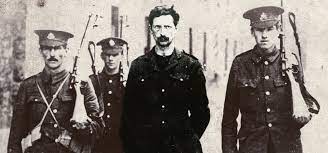
Tek other day. We marched this tall fella down. He’d bin in charge at bridge where Adjutant and Baz ‘ad been killed an’ we’d all got shot up. We half hoped he might try and mek a run for it so we could shoot him but he didn’t. As we gets to Richmond I sees a cameraman from’t newspapers and I seys ter prisoner
“ Aye up paddy, pull theesen together, gis us a smile, yer gonna be in’t paper”. He didn’t smile. He glared at camera, sucked his gut in, stood tall, ‘an he wer a big man. He wer right proud o’ what he’d done.
It wer a great picture. Me mam saw in’t Nottingham Evening Post, me grinning at back wi me rifle on me shoulder, bayonet proper fixed! She cut it out, took it ter werk, showed all er mates at shell factory.
We ‘ad ter stand guard at back o’ tall fellas court martial. Didn’t tek long, not more then ten minutes. All ther judges wer officers, only one bloke there wi a wig ‘an gown, proper barrister. Adjutant, he’d bin a barrister in Nottingham before he joined up, before he wer killed, by tall fella’s men.
‘An after court martial, we march yer tall fella back ter Kilmainham, him ‘aving bin sentenced to death by firing squad.
There were another one we ‘ad ter march abhat. Woman she wer. Captain Dixon toad us she were aristocracy. Only woman leader they ‘ad. We ‘ad ter march her from Kilmainham up ter another prison, across town,, where there were a proper woman’s wing. A Dublin metropolitan policeman came wi us to show us the way. Looked just like a Nottingham bobby really, tall fella, all coppers are tall fellas. Wore a helmet just like they do in Nottingham. He didn’t like us prisoner, toad us she’d shot an unarmed constable, one o’ ‘is mates, in the ‘ead, killed ‘im outright.
She wer in a bit of a huff, wouldn’t march at our pace, wanted to walk real slow, amble across city. It wer in early morning, before curfew wer lifted. I didn’t mind her walking right slow, I wer behind her and ter be honest, she had a lovely arse on her, proper woman’s arse, proud of itsen, nicest nicest arse that I saw in all o’ Dublin I reckon. I could ‘ave followed hat arise all the way to Tipperary. ‘an it’s a long way to Tipperary.
Wen we gets back, captain Dixon toad us we was to be in a firing squad an’ we’s ter shoot two o’ the paddies. Bit o a shock that. Some o’ lads gorra bit mouthy, asked if were to be the tall fella cause we all wanted to shoot him. Some wanted ter just bayonet ‘im, save us ammunition. But he won’t say who we wer to shoot.
We practised all afternoon. Captain wer not to shout fire or owut. He’d ‘oad his arm up wi ‘is sword, an when he drops it, we was to fire. More humane that way, he ses, paddy wou’t hear any command ter fire an’ won’t flinch from’t shots. There were two officers and 12 men, 12 shooters ‘an a Sgt. There wer a civi doctor, an’ a priest, he wer mor of a monk than a priest, wore one ‘o them monks habits. Ther wer another civi too, coroner I reckon.
Captain Dixon ‘ad is sword and lieutenant Mitchell wi ‘is service revolver, he wer to shoot paddy in ‘ed, if we missed. Coo deh grar he called it.
But we couldn’t miss really, not at that distance, we wer right close.
When we frst got ter Ireland, a lot o’ us, including mesen, we’d not yet fired us guns, we ‘ad to learn on job like, under fire from’t rebels. Before that, the rifles, they was just heavy lumps o’ wood an’ metal. But now they wer us right close maits.
Now, when yer put yer cheek ter stock ter tek aim, well it wer wi’ a sort o’ caress, we was familiar wi’ em now, wi’ their weight an’ balance,, we liked the feel of ‘em, the smell of the gun oil, the burnt brass o’ the shells an’ wiff o’ cordite, the good clean metallic slide o’ ther bolt, the kick when yer squeezed trigger, we knew us guns now, we weren’t gonna miss paddy, not at that distance.
Sgt, he pins this white cloth ont’ ter prisoner’s chest, above his heart, fer us to aim at. It were a bit of 4 by 2 as we used to clean us rifle barrels, he pins it on his chest, wi a safety pin.
A bloody safety pin.
We didn’t know who they were, the two we shot. Just a couple of paddies to us. Officer did call out names and such when he reads sentence, but it didn’t register wi us. They refused to wear any blindfolds, wanted ter look us in’t eye as we shot ‘em. I reckon that wer real reason for the bit of cloth on’t ther chests. We wouldn’t ‘ave to look ‘em watching us as we pulled the trigger.
Anyway, we aims twelve shots at his heart.
We couldn’t miss We shot his white cloth ter bits, shot is heart out. An’ captain puts his sword back in scabbard, and lieutenant ‘is revolver back in’t holster. Doctor certifies ‘im dead ‘an priest ses sum prayers, an’ we all march off to canteen fer hot tea, laced wi a bit o’ rum.
An those lads that ‘ad bin mouthing off before we shot ‘em, well they was quiet now. We was all a bit quiet ter be honest, none of us liked what we’d just dun. We’d joined up ter fight Germans in France, not the fucking Irish in Dublin, we were all volunteers yer know, we’d signed on ter fight like soldiers, not ter be executioners.
The shots had bin very loud in that yard. Everyone in prison must ‘ave herd ‘em. Echoed abhat, they did, against the walls, over the walls, across city, they must ave heard ‘em echoing all over early morning Dublin. Whole city knew what we’d done, ‘eard us doin it.
And those ‘as ‘eard ‘em, those paddies as ‘ad cheered us when we was marching int’ ter city, and them as who ‘ad mocked the rebels when they surrendered ter us, they turned against us nowh, after them shots. Yer could feel it, yer could taste it, even the good uns was saying that ther wer no need fer us to ‘ave shot ‘em. No need fer us ter ‘ave shot so many of ‘em.
Well ther yer are then, that’s what we did in Ireland, us Sherwood Foresters, us Robin Hoods, that’s what we did. Shooting paddies up ‘agen a wall.
We shot the hearts out of ‘em. Shot the heart out o’ Dublin, shot the heart out o’ Ireland we did. All that good stuff wi’ the British an’ Irish fightin together in France, we buggered it up. In’t end, up agen that Kilmainham wall, we just fucked it all up.
John McGuiggan
Mobile: 0868544594


I’ve been looking up my great-grandfathers service in C Coy, 2/7th Sherwood Foresters and had no idea the brigade walked straight into the Easter rising – literally!
I think he missed out on this incident and was posted to France and eventually wound up in the Labour Corp after being injured.
My Nottingham accent came out nicely reading this.
It does need a strong working class Nottingham accent!
This document describes how to use the dynamic debug (dyndbg) feature [url=https://www.kernel.org/doc/html/latest/admin-guide/dynamic-debug-howto.html]Dynamic debug[/url]