
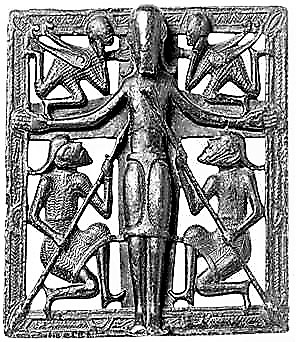
It is just perfect, perfectly appropriate, that this important 12th-century reliquary, an Irish Crucifixion plaque, should have been found, in of all places, an Irish potato field.
But so it was. And according to the notes of the archaeologist who found it, it was in the year 1844.
I check my notes.
Yes, 1844. Just one year before an Gorta Mor, the great hunger of the Irish potato famine that devastated rural Ireland and killed off the potato crop for the ensuing four years with the consequences of an estimated death from starvation of over a million and the emigration from Ireland of a further million, causing Ireland’s population to fall by 25%
The particular potato field holding the reliquary was in the North of Ireland,, in County Armagh, in the townland of Tynan. What was found was this small bronze metal plaque depicting Christ’s crucifixion.
There are adoring angels on either side of His head. At His feet, kneeling with spears, is, on the right, the Roman soldier Stephaton offering his vinegar soaked sponge to the wounds of Christ and on the left the Roman soldier Longinus thrusting a spear into the body of Christ.
It is a small plaque, measuring only 90mm by 90 mm, or in old money about 4 inches square. There are fixing points at each corner indicating that it was attached by nails or rivets to some wooden ecclesiastical object, but there is no consensus amongst scholars as to what that object might have been.
It is one of only eight such plaques found in Ireland. Originally it was known as the Dungannon plaque as the archaeologist and antiquarian collector, John Bell who found it, was employed as drawing master at the Royal school, Dungannon. Later scholars have renamed it as the Tynan plaque, mostly based on an entry in Bell’s notebooks of the time, now held by Glasgow University, which, with a small rough drawing of the plaque reveal that it was at Tynan that the plaque was discovered.:

The bronze plaque itself is held by the National Museum of Scotland, for Bell was by birth a Scotsman and upon his death he bequeathed his entire collection, all of which had gathered in Ireland, to the Society of Antiquaries in Edinburgh.
It was there in Scotland that it came to the attention of Anna Makac a talented icon artist, from Poland. She was attending the Edinburgh School of Icon Painting when she discovered the plaque and created from it this exquisite icon, painted in the traditional centuries old egg tempera technique. On board and measuring 6″ x 6″, slightly larger than the original plaque itself.
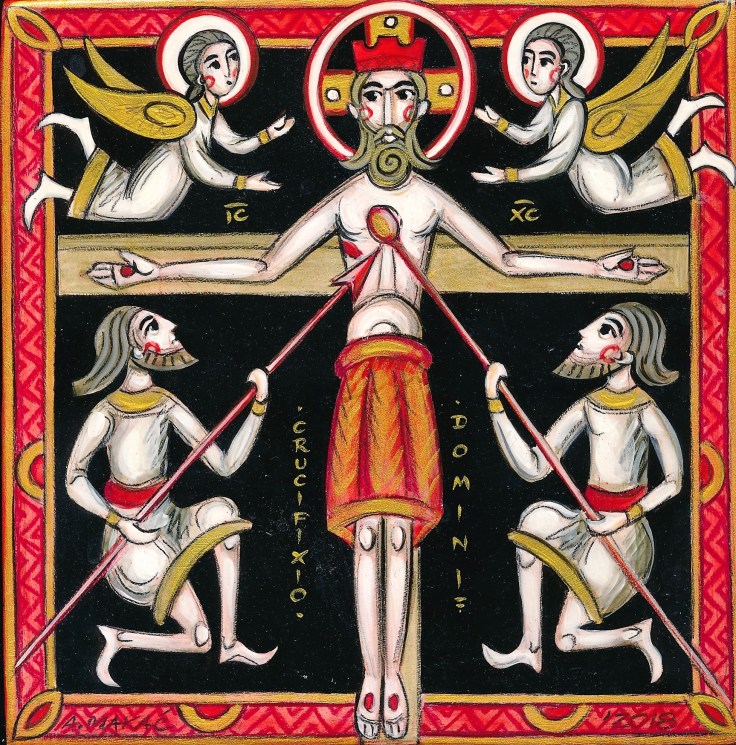
I came across the icon and bought it from her at an exhibition during the 2018 Edinburgh Festival. A small isolated exhibition at an old Edinburgh church, the St Vincent’s Scottish Episcopal Church, out towards Stockbridge. The church, one of Edinburgh’s treasures, is noted for being the British headquarters of the Military and Hospitaller Order of St Lazarus of Jerusalem, also known as he Leper Brothers of Jerusalem, with the flags or armorial colours of the various national Orders adorning the church interior, including amongst them, the colours of the Irish Order. 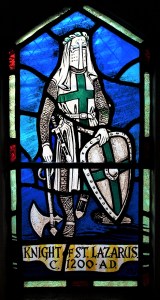
The church also hosts, in the entrance porch, a gorgeous stained glass window of the fully armed crusader knight, St. Lazarus with his military shield, bearing the green cross of the Order, a green cross familiar now as the international symbol of pharmacies throughout Europe.
There in the north transept of the church Anna and her colleagues from the Edinburgh School of Icon painting, hung their small and very beautiful collection of religious icons.
 The exhibition, “The Art of the Icon” was a modest affair, part of the Sacred Arts Festival that runs alongside the Edinburgh Fringe and International Festivals, and which features, in various churches around the city, sacred music, gospel choirs and such like.
St. Vincent’s church being out towards the Stockbridge area of the city was a little off the beaten track for most Festival goers and visitors to the exhibition were not therefore as numerous as they might have been had it the exhibition been held closer to the city centre. Discovering it was one of the highlights of that year’s festival and finding this exquisite image of the Irish Tynan plaque, well, it was like finding your own potato field.
 Broadsides - A collection of bits and pieces
You were a lucky man indeed John to find this. She did a magnificent job! I’ve just had a walk down College Hall Lane on Google Maps. Looks to be a lovely area, very similar to where I grew up.